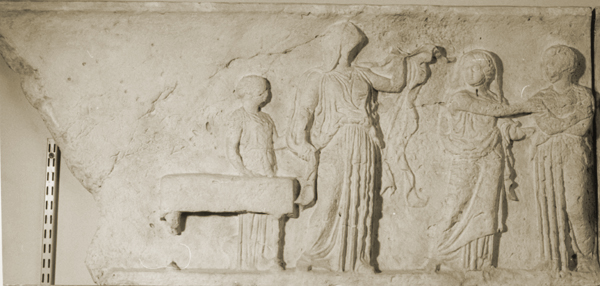
Relief showing three women and a girl.
Commentary Prepared by Dr. Julia Lenaghan, Ashmolean Museum
A 119 A
Odysseus Slaying the Suitors; Trysa Heroon South Wall
Limestone
Architectural Relief
W (total) 761 cm
First discovered in 1841 but soon forgotten, the Trysa heroon was rediscovered in 1881 by Otto Benndorf, then Professor of Classical Archaeology in Vienna. In 1882/83 the friezes of the heroon were transferred to Vienna.
Austria, Vienna, Kunsthistorisches Museum
Late Classical, ca. 370 BC
Preservation:The entire surface of the relief is heavily weathered. The original left side of the slab has broken off; a large fragment joins break to break in the upper left corner. The faces of the second woman from the left and of the woman furthest to the right are destroyed.
Description:The relief shows a group of four female figures in a domestic setting. To the left is a wide stool, behind it a girl in a peplos, seen in three-quarter profile from the right. She is followed by a tall woman, depicted almost frontally but slightly turned to her left, clad in a sleeveless chiton and a veil that is partly draped over her head and held up with her left hand. After that follows another woman, wearing a peplos and a himation that also covers her head. She stands frontally but has turned her head back to the tall woman by her side and points with both hands in the opposite direction. To the right stands another woman, clad in a peplos, her arms held in front of her chest.
Discussion:The Heroon at Trysa (a town in the ancient region of Lycia), is situated close to the modern village
of Gölbasi in south-western Turkey. The monument is set on a slope between the acropolis to the west and the main necropolis immediately to the east. Essentially a funerary precinct, it was enclosed by a peribolos wall three metres high, and built in a rectangle measuring roughly 20x24m, with a monumental gate in the south. The outside of the south wall and all four interior walls were decorated with two superimposed relief bands carved of local limestone, measuring 211m in total. In the centre of the precinct stood a monumental, two-storeyed sarcophagus in the shape of a house, containing the remains of the local dynast whose name unfortunately is not preserved. Smaller sarcophagi for further members of the ruler’s family are preserved in fragments.
The heroon has attracted scholarly interest mostly because of its distinct plan and the unusual choice of its relief decoration. Not only is the entire repertoire of Lycian grave monuments represented (battle scenes, hunts, banquets, ruling couple, ruler on a chariot) but there are also Egyptian influences (for example in the depiction of the Egyptian god Bes on the gate). Most important and almost unparalleled, however, is the extensive display of a great variety of Greek, particularly Attic, myths on a single monument: Odysseus and the Suitors, the Kaledonian Boar Hunt, Amazonomachy, Centauromachy, Theseus cycle, Seven against Thebes, Rape of the Leukippids. Still not precisely identified are the battle scenes and the city siege. Many of these myths appear twice.
The use of two superimposed friezes is very much in the oriental tradition and cannot be found on Greek monuments; at Trysa the frieze bands can carry unrelated scenes, but sometimes they are united into one depiction of considerable spatial depth.
One of the typical scenes of Greek mythology depicted on the Trysa heroon is the return of Odysseus to his native Ithaca and the punishment of the suitors who had attempted to win his faithful wife Penelope. This event was depicted on the upper register of the inner frieze on the south wall, to the left of the gate.
The narrative begins inside the royal palace: In the centre of the first slab, marked out by her tall figure, is Penelope. She has just risen from a stool, surrounded by her maids. The first maid on the right half of the slab could be the loyal Eurykleia, who is pointing towards the dramatic scene unfolding further to the right.
Bibliography:O. Benndorf and G. Niemann,
Das Heroon von Gjölbaschi-Trysa (Vienna 1889) esp. 96-105 pls. 7-8
The basic first publication of the monument.F. Eichler,
Die Reliefs des Heroon von Gjölbaschi-Trysa (Vienna 1950) esp. 55-57 pls. 6-7
Detailed guide with a description of the monument and the individual reliefs.R. Noll,
Das Heroon von Gjölbaschi-Trysa. Ein fürstlicher Grabbezikr griechischer Zeit in Kleinasien [= Führer durch das Kunsthistorische Museum Nr. 16] (Vienna 1971) esp. 4
A short guide with a detailed description of the various reliefs.W. A. P. Childs,
"Prolegomena to a Lycian Chronology, II: The Heroon from Trysa" (RA 2 1976) 281-316
Gives a detailed stylistic comparison between the reliefs from Trysa and sculptures from the Greek mainland and the rest of Lycia. The Heroon at Trysa is dated to ca. 370 BC.C. Bruns-Özgan,
Lykische Grabreliefs des 5. Und 4. Jahrhunderts v. Chr. [= IstMitt Beiheft 33] (Tübingen 1987) 56-81; 256-257 pls. 9-11.2; 12-13.2
Argues that the friezes from Trysa show an advanced style of ca. 370 BC and are influenced by the iconography of Greek paintings of the Classical period, probably through the use of established pattern books.B. S. Ridgway,
Fourth-Century Styles in Greek Sculpture (London 1997) esp. 88-94 pls. 24-25
Good summary and bibliography of previous research on the heroon.