Cast Gallery catalogue number: A115
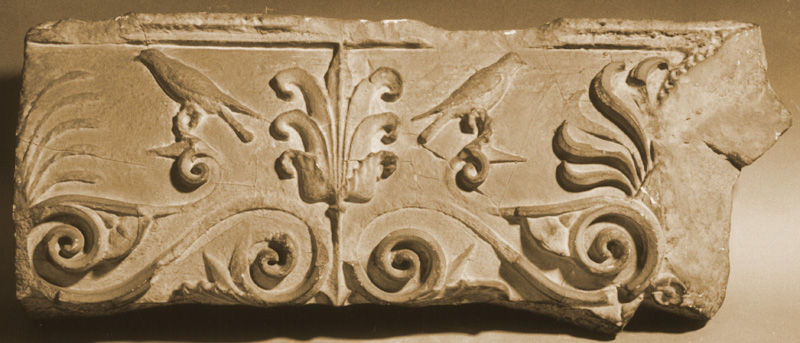
Fragmentary relief with birds and florals.
- Plaster cast: Height: unavailable.
- Copy of a fragment of an architectural relief.
- The fragment:
- was made around 400 BC.
- is from the sima of the second Temple of Hera at the Argive Heraion.
- is now in Athens, National Museum.
Detailed Record
Commentary Prepared by Dr. Julia Lenaghan, Ashmolean Museum
A 115
Fragment of sima from Argive Heraion. Athens
Portion of sima (frieze around bottom of lateral edge of roof) with a central lotus motif, vegetal scrolls, and cuckoos. From the second temple of the Argive Heraion, ca. 400 BC.
Marble
Architectural Element
H ca. 22 cm, L 56.5 cm
From the Argive Heraion. Found in 1892 in the excavations carried out by the American School of Athens.
Greece, Athens, National Museum
Ca. 400 BC
Preservation:The fragment is broken on the right side. The left side appears to be smoothly worked join surface. The lower edge is also broken. The upper molding is chipped above the cuckoo on the right and near the left corner.
Description:The fragment is a decorated block from the sima of the temple. It has a central anthemion element in the form of a six-petalled lotus. This lotus rises between two broad scrolling volutes. It is flanked by two birds, cuckoos, who face away from the lotus. The birds are perched on a smaller scroll, that is connected to another vegetal design with radiating fringes. On neither side is this radiating vegetal design fully preserved. On the right side, above and to the right of this vegetal design, an edge of a mane of a lion is visible.
Discussion:This fragment of a decorated sima comes from a temple of Hera at the Argive Heraion. The Argive Heraion was a sanctuary located on the eastern part of the plain of Argos, five kilometers from Mycenae and ten from Argos. The temple, to which this fragment belonged, is generally dated ca. 400 BC; it replaced an earlier temple. For a fuller discussion on the sanctuary and this temple, see cat. no. A 109 and for other sculpted fragments from the temple, see cat. nos. A 110-114, A 166, and A 167.
The decoration consists of a central lotus plant, vegetal scrolls, and birds. The birds are thought to be cuckoos, birds that were particularly related to Hera. They frequently appear on the sceptre of Hera. Not only did the cuckoo stand for gentleness, peace, and love, but it also was said that Zeus first approached Hera in the form of a cuckoo. The elegant and simple decoration was punctuated by lion-head waterspouts (cf. cat. no. A 166 and 167) of different sides which drained rain water off the raking roof of the temple. This particular sima decoration which includes cuckoos is unique in that it features elements that directly relate and recall the divinity honoured by the temple.
Julia Lenaghan
Bibliography:C. Waldstein,
Excavations of the American School of Athens at the Heraion of Argos, 1892 (London 1892) 16, pl. 7
brief descriptive catalogue-like entryS. Karouzou,
National Archaeological Museum. Collection of Sculpture (Athens 1968) 59
possibly mentioned under no. 1581-1582, no. 3973 pl. 28b is a different fragmentB. S. Ridgway,
Fourth-Century Styles in Greek Sculpture (London 1997) 27-28
mention of the sima as novel element of temple