Cast Gallery catalogue number: A090
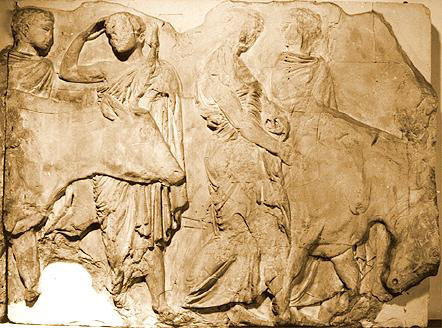
Youths with sacrificial animals.
- Plaster cast: Height: 1.04m.
- Copy of part of a marble frieze.
- The frieze:
- is from the south end of the Parthenon.
- was made about 440 BC.
- This part of the frieze was brought to London in the early 1800s and is now in London, British Museum.
Detailed Record
Commentary Prepared by Dr. Julia Lenaghan, Ashmolean Museum
A 090
Youths and Cows (Slab 45 [42]); Parthenon Frieze South
Marble (Pentelic)
Frieze
W 134 cm
The slab belongs to the large section of the frieze removed by Lord Elgin in 1802 and was subsequently transferred to London.
United Kingdom, London, British Museum
High Classical, ca. 440-432 BC
Preservation:The original border of the slab is preserved on the left side (and perhaps partly on the right). All corners except for the upper left are missing. The surface of the relief, especially on the right half of the slab, is heavily worn. The faces of all figures, except for the one on the right, are obliterated. A further figure on the far right is only partly preserved in outline. The right border of the cast does not quite coincide with the original border of the slab. The head of the right cattle appears to be restored.
Description:The slab shows parts of two cattle and traces of five figures, all walking to the right. On the left is the front part of an animal, and on its flank the hand of a figure from a neighbouring slab. Behind it are a figure depicted in right profile, tightly wrapped in a himation, and a second man, seen frontally, who has turned and seems to put on or adjust a wreath or band with his right hand that is raised to his head. Before them, on the right half of the slab, walks another group. The cattle there has lowered its head down to the ground, followed by the gaze of a man depicted in the foreground who leads it on a (painted?) rope, of which no traces remain. Behind the cattle is another man, further to the right faint traces of a yet another figure.
Discussion:The slab depicts another part of the procession of the sacrificial cattle from the south frieze (cf. A 88-89). Poses and dress of the figures are skilfully varied. The different character of the individual cattle is masterfully represented.
Bibliography:F. Brommer,
Der Parthenonfries (Mainz 1977) 103-104 pls. 157-158
A very detailed study of the Parthenon frieze including previous bibliography and ample photographic documentation.I. Jenkins,
The Parthenon Frieze (London 1994) 72-73
The latest official documentation of the frieze by the British Museum. Jenkins has renumbered some of the slabs and put them in a different order.E. Berger and M. Gisler-Huwiler,
Der Parthenon in Basel. Dokumentation zum Fries (Basel 1996) 143 pls. 116-117
Detailed study of the Parthenon frieze based on the reconstruction in the Basel cast collection, including an extensive bibliography.