Commentary Prepared by Dr. Julia Lenaghan, Ashmolean Museum
A 086 H
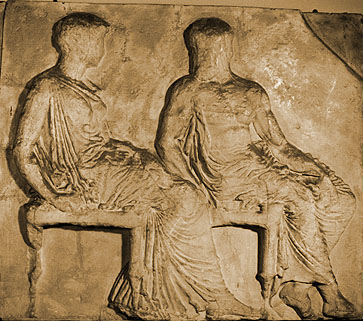
Athena and Hephaistos (Slab 5); Parthenon Frieze East
Marble (Pentelic)
Frieze
W 119 cm
The slab was probably first removed from the frieze when the Parthenon was converted into a Christian church. It was not drawn by Carrey, but later by Stuart who saw it incorporated into medieval or Turkish fortification walls on the Acropolis. From there it was removed by Lord Elgin in 1802 and subsequently transferred to London.
United Kingdom, London, British Museum
High Classical, ca 440-432 BC
Preservation:The surface of the entire relief is heavily worn and abraded, the upper right corner of the slab is missing. The facial features of both figures are almost entirely obliterated. The chest of the figure on the right is heavily scored; the left leg of the woman’s stool has mostly broken off.
Description:The relief shows two figures seated on stools. To the left and slightly in the foreground, is a female figure depicted in right profile. She wears a long, sleeveless garment and sandals. Her left arm rests in her lap, around the left hand appears to be a fringe of snakes. Her right arm is held downwards, the right hand rests on the stool. There are three dowel holes (on her right upper arm, her body, and the stool) for the attachment of a metal attribute. Her left foot is set forward, her right foot back and under the stool.
Further to the right and closer to the relief ground is a bearded man. He has turned back to face the woman, so that his torso appears almost frontally and his head in three-quarter profile from the left. The man is barefoot and wears only a himation that is tightly wrapped around his lower body and taken up under his right armpit with which he rests on a staff. His right leg is set forward, the left leg back.
Discussion:The two gods depicted here form the beginning of the right half of the divine assembly on the east frieze. They are clearly marked out by their great size from the mortals around them. The female figure on the left is Athena. Her importance is underlined by her position in the frieze that corresponds symmetrically to the figure f Zeus further to the left (A 86e). The goddess is bareheaded; her attribute, the aegis, is held in her lap, most of the details were rendered only in paint. In her left she originally probably held a spear that was added in metal. The male god next to her must be Hephaistos, whose cult was closely linked to that of Athena. Of all the gods depicted on the east frieze, he alone leans on a staff, perhaps an allusion to his lameness.
Bibliography:F. Brommer,
Der Parthenonfries (Mainz 1977) 112-116 pls. 163, 1.2; 165; 177
A very detailed study of the Parthenon frieze including previous bibliography and ample photographic documentation.I. Jenkins,
The Parthenon Frieze (London 1994) 79
The latest official documentation of the frieze by the British Museum. Jenkins has renumbered some of the slabs and put them in a different order.E. Berger and M. Gisler-Huwiler,
Der Parthenon in Basel. Dokumentation zum Fries (Basel 1996) 160-161 pl. 135
Detailed study of the Parthenon frieze based on the reconstruction in the Basel cast collection, including an extensive bibliography.