Commentary Prepared by Dr. Julia Lenaghan, Ashmolean Museum
A 086 E
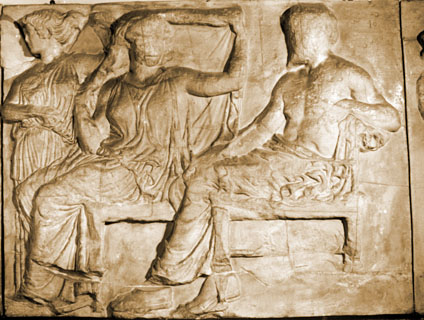
Zeus, Hera, and Iris (Slab 5); Parthenon Frieze East
Marble (Pentelic)
Frieze
W 130 cm
The slab was probably first removed from the frieze when the Parthenon was converted into a Christian church. It was not drawn by Carrey, but later by Stuart who saw it incorporated into medieval or Turkish fortification walls on the Acropolis. From there it was removed by Lord Elgin in 1802 and subsequently moved to London.
United Kingdom, London, British Museum
High Classical, ca. 440-432 Bc
Preservation:The surface of the relief is heavily worn and abraded. The lower rim of the slab has broken off and is restored on the cast, only on the left a larger fragment with the feet of both figure is preserved. The heads of both of the seated figures are battered and worn, their faces obliterated. A further fragment (in the Acropolis Museum, Athens) with the head of the standing figure on the left joins on the upper left corner and has been included in the cast.
Description:The scene depicts two seated and a smaller standing figure, all facing to the left. To the right sits a mature, bearded man on an ornate, throne-like chair with backrest and an armrest supported by a sphinx. He is nude except for a himation that covers his body from the waist down and is partly draped over the backrest of the throne. On his feet he wears sandals; the left foot is set forward, the right foot slightly back and half under the throne. The man has turned slightly, so that his left arm rests on the backrest of the throne, and the right arm on his leg. A sceptre is held in his right hand, the upper half sculpted in relief, the missing lower half originally added in metal.
In front of him and slightly to his right sits a female figure on a much simpler stool. She is clad in a long, sleeveless chiton and has turned back to the male figure behind her. With both hands she raises a veil that covers her head.
Next to her to the left stands a smaller female figure. She is winged, and wears a peplos. While she stands frontally, her head is turned into the left profile. Her right arm is turned horizontally in front of her body, the left arm is raised and may have held a lost or painted attribute.
Discussion:The three figures depicted here complete the left section of the assembled Olympian gods from the centre of the east frieze. To the right is Zeus, marked out by his more elaborate throne and sceptre, followed by Hera, who has turned to him, and in a typical gesture of bridal communion unveils herself. At her side is the much smaller figure of another deity, either Nike or Iris; Iris, the divine messenger in the service of Zeus and Hera is perhaps the more likely identification. The smaller scale illustrates her subordinate role and corresponds to the figure of Eros on the other side of the east frieze (see A 86j).
Bibliography:F. Brommer,
Der Parthenonfries (Mainz 1977) 112-116 pls. 163.1-2; 174-175
A very detailed study of the Parthenon frieze including previous bibliography and ample photographic documentation.I. Jenkins,
The Parthenon Frieze (London 1994) 78-79
The latest official documentation of the frieze by the British Museum. Jenkins has renumbered some of the slabs and put them in a different order.E. Berger and M. Gisler-Huwiler,
Der Parthenon in Basel. Dokumentation zum Fries (Basel 1996) 155-161 pl. 133
Detailed study of the Parthenon frieze based on the reconstruction in the Basel cast collection, including an extensive bibliography.