Commentary Prepared by Dr. Julia Lenaghan, Ashmolean Museum
A 086 C
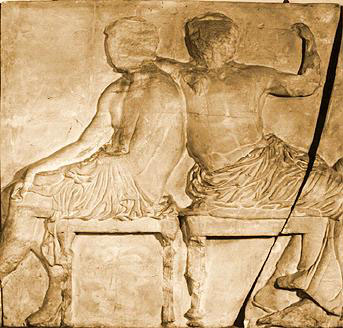
Hermes and Dionysos (Slab 4); Parthenon Frieze East
Marble (Pentelic)
Frieze
W 97 cm
The slab belongs to the large section of the frieze removed by Lord Elgin in 1802 and was subsequently transferred to London.
United Kingdom, London, British Museum
High Classical, ca. 440-432 BC
Preservation:The surface of the relief is worn. A large section of the heads of both figures has broken off, so that their faces are entirely obliterated. The left leg of the figure on the left, both arms of the figure on the right, and the legs of the two stools are chipped.
Description:Depicted are two men sitting back to back on stools. The figure on the left is nude except for a garment loosely draped around his waist. He sits in a relaxed pose, both arms on his lap. The left arm is covered by the drapery; the right hand, resting on the knee, shows a drill hole for the attachment of a metal attribute. A hat (petasos) is visible on the left leg. The man wears boots, their painted details are lost. His companion has turned back, so that his torso is shown frontally. His raised right arm rests casually on the first man’s right shoulder, his left arm is raised upwards to the side of the body and must have held a long attribute of which no trace remains. His head was turned back further and shown in left profile; some dowel holes for the attachment of a metal wreath are preserved. This man wears sandals and has a himation draped around his waist; he sits on a flat cushion. (The legs of both figures are represented on A 86b and c.)
Discussion:The two figures represented here belong to the assembly of the twelve Olympian gods from the centre of the east frieze. To the left, identified by his characteristic petasos (hat) sits Hermes, the divine messenger. In his right hand he must have held his kerykeion, while wings may have been painted on his boots. The god next to him is usually identified as Dionysos; his raised left should then have held a thyrsos staff, one of his typical attributes.
Although they are seated, the heads of the gods are on the same level as those of the standing human figures around them, their divine might thus indicated by their imposing stature. Seemingly aloof to the so-called peplos-scene in the centre, the gods face outwards to the approaching strands of the procession.
Bibliography:F. Brommer,
Der Parthenonfries (Mainz 1977) 110-112 pls. 163.1-2; 170.3-4; 171
A very detailed study of the Parthenon frieze including previous bibliography and ample photographic documentation.I. Jenkins,
The Parthenon Frieze (London 1994) 77
The latest official documentation of the frieze by the British Museum. Jenkins has renumbered some of the slabs and put them in a different order.E. Berger and M. Gisler-Huwiler,
Der Parthenon in Basel. Dokumentation zum Fries (Basel 1996) 152-155; 175 pls. 131-132
Detailed study of the Parthenon frieze based on the reconstruction in the Basel cast collection, including an extensive bibliography.