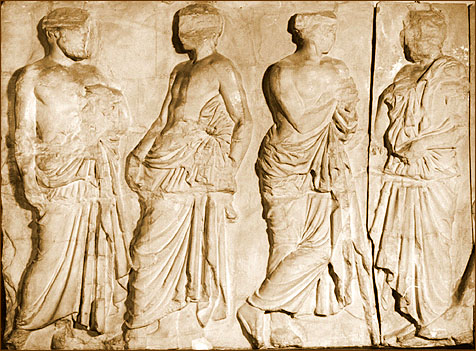
Athenian heroes.
Commentary Prepared by Dr. Julia Lenaghan, Ashmolean Museum
A 086 A
Eponymous Heros ? (Slab 4); Parthenon Frieze East
Marble (Pentelic)
Frieze
W 109 cm
The slab belongs to the large section of the frieze removed by Lord Elgin in 1802 and was subsequently transferred to London.
United Kingdom, London, British Museum
High Classical, ca. 440-432 BC
Preservation:The heads of all figures are severely damaged; of the left figure only the lower half of the face is preserved, of the middle figure only the right half of the face closest to the relief ground, while the face of the man on the right is entirely obliterated. An almost horizontal break runs through the entire relief just below the middle, all figures are scored along this break. Their hands, arms, and feet are chipped. (The cast shows only the left section of the slab.)
Description:Depicted are three men standing next to each other, the one on the left bearded, the other two clean-shaven. They are bareheaded and wear himatia without undergarments, leaving their chests exposed, and sandals. Instead of being draped over the left shoulder in the usual manner, here a section of the mantle is gathered as a thick bundle under the left armpit to serve as a cushion for the long staff on which all three men lean in a relaxed pose. The two men on the left face each other in three-quarter profile. The first man’s right arm is held alongside the body, while the left is bent and led over the chest to hold the (painted?) staff. His companion is leaning back slightly, his weight supported by the staff. Both his arms are held downwards, the left probably leant against the staff, of which no traces are preserved. The man on the right stands in a relaxed pose with his legs crossed, both arms held in front of the chest where they rest on his plastically rendered staff.
Discussion:The cast shows three men from the southern part of the east frieze. They form part of a larger group of six, arranged as three pairs of two men facing each other in conversation, and correspond to four very similar figures to the right of the central scene. Thus, they establish a link between the procession on the corners and the assembled gods in the centre of the east frieze. Because of their relaxed manner, seemingly detached from the procession around them, their number, their ‘heroic’ hairstyle (mostly long hair and, in some cases, beards), and their characteristic staffs - other figures on the frieze do not have them - they have often been interpreted as the ten eponymous heroes of Athens and attempts have been made to assign individual names to them. A different interpretation sees the figure closest to the procession as a marshal and the others, accordingly, as civic dignitaries rather than heroic figures, for example nine archons (with the tenth represented in the central scene). Alternatively, the ten men have been identified as athlotetes, the officials in charge of the Panathenaic procession.
Bibliography:U. Kron,
Die zehn attischen Phylenheroen (= AM, 5. Beiheft) (Berlin 1976) 202-214 pls. 30-31
Discusses the figures on the Parthenon frieze among other evidence for the Attic tribal heroes.F. Brommer,
Der Parthenonfries (Mainz 1977) 110-112 pls. 163.1-2; 170.3-4; 171
A very detailed study of the Parthenon frieze including previous bibliography and ample photographic documentation.I. Jenkins,
The Parthenon Frieze (London 1994) 77
The latest official documentation of the frieze by the British Museum. Jenkins has renumbered some of the slabs and put them in a different order.E. Berger and M. Gisler-Huwiler,
Der Parthenon in Basel. Dokumentation zum Fries (Basel 1996) 152-155; 175 pls. 131-132
Detailed study of the Parthenon frieze based on the reconstruction in the Basel cast collection, including an extensive bibliography.