Cast Gallery catalogue number: A044
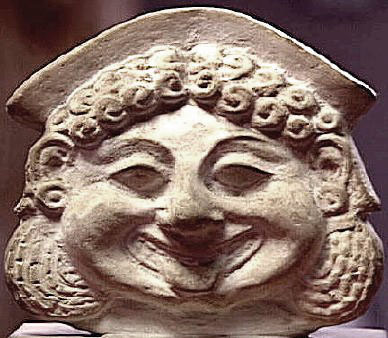
Clay antefix, gorgoneion.
- Plaster cast: Height: 18cm.
- Copy of a clay roof decoration made about 530-500 BC.
- The roof decoration:
- was found at Gela in Sicily.
- is now in London, British Museum.
Detailed Record
Commentary Prepared by Dr. Julia Lenaghan, Ashmolean Museum
A 044
Gorgoneion Antefix from Gela. London
Terracotta
Architectural Element
18 cm
From Gela in Sicily.
United Kingdom, London, British Museum, 1137
late Sixth Century or Fifth Century BC
Preservation:The antefix has broken off at its back side. The left ear and the hair to the right of the chin are restorations. The clay has a pale orange surface and details in black glaze are preserved.
Description:The antefix depicts the head of a gorgon. The gorgon wears a crown that rises a few inches above the head and extends between the ears. It also wears earrings that are shaped like phiale. The hair of the gorgon is cut short around the brow. At the front of the head between the ears the hair lies in two tiers of snail curls which are parted at the center directly over the nose. The rest of the hair is gathered in either a bunches behind the left ear or a bunch behind the right ear. The bunched hair on each side is rendered in long coils. Tied together by a band at the level of the ear, it falls downwards to the level of the chin. When it reaches this level, the bunched hair loops back upward and an end escapes out of the band. The escaping end juts outwards from the head at the level of the ear lobe.
The face of the gorgon is broad and short. The hair over the brow forms a triangle with two equal sides and its upward peak at the center part. The eyebrows are raised arches that originate at the root of the nose. Between the eyebrow and the upper eyelid is a backward slanting space out from which the upper eyelid bulges. The upper eyelid is heavy whereas the lower eye lid is merely a line. Beginning at the outer corner of the eye and moving toward the ears are two sets of raised lines. The nose is short and broad. The naso-labial folds are deepened by the large smile of the head. The “U” shaped mouth is outlined by the lips which are raised bands that connect at the corners in smooth oval sections. Two tiers of regular rectangular teeth are visible between the lips and a small lip protrudes over the central teeth of the lower level. The end of the tongue is ovoid and through the center there is a depression.
Discussion:The two dimensional terracotta representation of a gorgon’s head was certainly an antefix and terracotta gorgoneion antefixes were popular in Sicily and Western Greece from the second half of the six century onwards. This example from the British Museum is one of many found at Gela. It appears specifically to belong to a particular group which is united by several characteristics: 1) the crown, 2) the phiale-shaped earrings, 3) the ends of the hair which shoot outwards at ear level, 4) the bands that tie the hair near the ears, 5) the two rows of snail curls that frame the face, 6) the two rows of teeth and the small protruding tongue, and 7) the thick upper eyelids. Of this group of Gorgon antefixes that may have decorated the same building Belson cites two in the Syracuse museum and one in the Gela Antiquarium. One of these surely came from an area adjacent to the acropolis. More recently similar examples have been found in the periphery of ancient Gela, both at Manfria and a Capo Soprano. Panvini suggests that the Capo Soprano gorgoneion antefix came from a terracotta workshop where either the ancient mold was being reused in the Hellenistic period (2nd half of the fourth century BC) or that it was a Hellenistic archaizing creation.
Thus, the original location in Gela of the British Museum terracotta remains uncertain. The date of the antefix is similarly questionable. Van Buren (1957) notes that one from north of the acropolis was found under an archeological level which dated to ca. 405 BC. Because of the earrings and the crown, van Buren (in 1923) had placed the British Museum antefix in the second half of the fifth century. Higgins, citing the same details, dated the terracotta to the first half of the fifth century. Darsow thought it was even older and put it in the late sixth century or early fifth century. The gorgoneion type was compared to that on the aegis of Athena from the pediment at Eretria the date of which has recently moved forward into the fifth century.
Bibliography:E.D. van Buren,
Archaic Fictile Revetments in Sicily and Italy (London 1923) pp.21 and 144 no.36
dates to the second half of the fifth century because of the round face, crown, and earringsW. Darsow,
Sizilischen Dachterrakotten (Berlin 1938) p.15 B II, c-I
lists the similar antefixes found at Gela and dates them to the late sixth or early fifth century BCR.A. Higgins,
Catalogue of the Terracottas in the Department of Greek and Roman Antiquities, British Museum I (London 1954) pp.309-310 no. 1137
catalogue entry which dates the antefix to the early fifth centuryE.D. van Buren,
"News Letter from Rome" (AJA 61 1957) pp.384-385 pl.113 fig.33
mentions another similar Gela antefix with contextJ.D. Belson,
The Gorgoneion in Greek Architecture (Bryn Mawr 1981) I p.105, 122-127 and II pp.116-117 entry 11
notes this antefix among a series of similar oneR. Panvini,
Gelas (Turin 1996) pp.113-114
discusses a very similar antefix found at Capo Soprano in perhaps a Hellenistic terracotta workshop