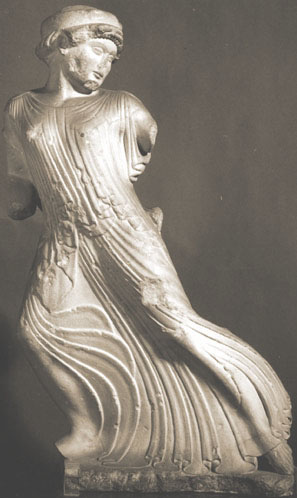
Girl running.
Commentary Prepared by Dr. Julia Lenaghan, Ashmolean Museum
A 043
"Running Maiden", perhaps Hekate from a pediment. Eleusis
Marble (Pentelic)
Pedimental Figure
64.5 cm
From Eleusis. Found outside sanctuary near the South Gate.
Greece, Eleusis, Eleusis Museum, 5235
ca. 490-475 BC
Preservation:The plinth of the statue is broken on all sides. The left arm from the upper arm down, the right arm from just below the elbow down, the front of the right foot, and the nose are missing. The end of the mantle behind the left side of the body has broken off and is also missing. There are chips on the front of the left thigh, on the chin, and in the hair over the brow on the both the left and the right sides. There are small remnants of struts on rightmost edge of the right thigh and on the drapery which streams up over the left shin. At the back of the head there is a smoothed band near the hair line on the neck in which there are five regular holes.
Description:The statue depicts a female in a peplos who moves vigorously to her right. Though moving to the right, the body faces forward. The left leg extends in a diagonal line which runs from the hip to the ground to the left of the body. The left foot, the front half of which is visible, is raised so that only the large toe and the tips of the two adjacent toes touch the ground. The figure is lifting its weight off of this leg. The right leg, which bears the body, is bent at the knee. The upper leg extends diagonally from the hip to the right of the body and the lower leg moves from the knee, which projects to the right of the body, down and to the left; that is, it moves back under the body. The right foot, covered by the drapery and seen in profile, points to the right.
The upper body leans to the right. The right arm drops straight down from the shoulder and bends at the elbow. The right forearm seems to have come slightly forward. The left arm was also lowered and appears to have moved to the left of the body. The head is turned over the left shoulder and looks downward. It is seen in profile.
A peplos is worn over the body. This one large piece of material, the upper portion of which is folded downwards. With the crease of this fold as the upper border, the garment is wrapped from the back of the right side around the body until the front of the right side. The upper border at the back is fastened to the upper border at the front tat the shoulders. The excess width of the material hangs down from the fastenings at the shoulder and the bottom edges of the folded section reach the waist. Again the excess width of the material collects at the sides of the body and hangs further down. Here the longer portion of the overfold is visible on the outer and back side of the upper left thigh and a hanging corner appears on the inner side of the right thigh. Along the right side of the body where the two lateral edges of the peplos meet is unfastened and consequently open.
The peplos is depicted in flat folds which decorate the surface of the figure. For instance, the folds of both the bottom hem and the bottom of the overfold end in flattened omega folds. Moreover, on the lower body the swift movement of the body to the right causes the peplos to flow backward. On the inside of the right lower leg at about knee level are a series of especially large folds which slightly move downward, horizontally to the left, and then move downward with a small curve to the right. Between these folds and the left leg are a series of three long folds which move from the middle of the waist downward and to the left. These folds finish in large omega patterns, the two rightmost of which bend to the right. On the left the leg the folds fall so that when they reach the left lower leg they flow off it to the left and upwards.
The figure also wears a mantle which is visible at the right upper arm. Wrapped around the biceps, it lies around the back of the figure. Presumably also wrapped around the left arm, it hangs in a downward arching band between the arms behind the back. At its lowest point the band of the mantle reaches the buttocks.
The head of the figure wears a diadem which is a solid band that rises vertically off the head. The hair is divided into two sections at the ears. In front of the ears the hair is combed forward and cut short. It lies in three tiers of snail curls. Only the strands leading to the uppermost row of snail curls are visible; they are delineated by engraved closely packed straight lines. At the back of the head the hair is longer and lies in thick locks which are delineated by widely spaced lines. At the hairline on the nape there is a smooth shelf which has five evenly spaced holes into which an additional piece of hair was inserted.
The face of the figure is broad and short. The brow, on to which hang the three rows of snail curls, appears low. The eyebrows arch regularly and there is a flat space between them and the upper eye lids which follow the same arch and which are projecting bands. The lower eye lids, again defined bands, are more horizontal. The mouth is small and features thin lips which project from the face. The outer corners of the mouth are slightly raised and the central portion of the upper lip features a downward point.
The back of the statue is less carefully worked than the front. The folds and details are rendered even more flatly.
Discussion: The statue clearly belongs to an architectural setting. The plinth is broad and not deep. The composition is frontal with left to right movement and the back is only summarily executed. The pose, moreover, implies a narrative setting with other figures.
Equally secure is the general date of the figure which must fall between 490 and 475 BC. For stylistic reasons scholars either date it to the decade of 490-480 BC, considering it late Archaic, or in the period shortly after 480, considering early Classical. The statue is often compared and placed slightly after the sculpture of the Athenian Treasury at Delphi which is dated ca. 490 BC. The argument of date must also consider whether the statue had been standing in place when Eleusis was destroyed by the Persians in 479 BC or whether it was made after the destruction. Willemsen pointed out that the paint preserved in the eyes of the statue suggested that it had not been exposed to the elements for a long time.
The identification of the figure presents greater difficulties. Because the statue was found outside the sanctuary of Eleusis, it was identified as Kore or one of her attendants in flight from Hades who had emerged from the Underworld. Edwards points out two fundamental problems with this identification. First, the figure does not seem to be fleeing in fear and the two struts, one on the outside of the right thigh and the left shin, cannot be explained. Second, Edwards notes that multi-figured scenes that depict the Rape of Persephone do not appear in vase painting before 430 BC.
In regard to the first problem, Edwards convincingly shows that the iconography of the figure is suitable for Hekate who leads Persephone out of the underworld. The statue looks appropriately downwards and could easily have been holding two torches which would explain the broken struts. Hekate appears in this guise and position in scenes of the anodos of Persephone in vase painting; for instance, the name vase of the Persephone Painter in NY and a lekanis lid formerly Berlin.
Willemsen had attempted to associate other sculpture found at Eleusis with this statue. He suggested a winged torso and a head (Athens, National Museum 60). Although both of these works are contemporary, neither seems likely to have belonged to the same building as the “Running Maiden.” A winged figure, probably a Nike, is an unlikely figure in either a scene of the Rape of Persephone or the Anodos of Persephone. Moreover, the statue is fully finished on all sides. The head, which he suggested, does not have enough similarities to be considered and is slightly larger. Edwards reintroduces a head mentioned by Himmelmann (Athens, National Museum 62) as potentially from the same sculptural program. This head also has in not fully worked out at the back and has holes for the attachment of extra hair. Moreover, it was intended to be seen at an angle. Edwards suggests that this would be a suitable head for Demeter.
The exact building to which the figure belonged is impossible to determine. Since the “Running Maiden” was found outside the sanctuary near the south gate, it had initially been thought that the statue adorned a building with the sanctuary and had been dumped outside the sanctuary when that building was refurbished. The head (Athens, National Museum 62) was found inside the sanctuary and if it does indeed come from the same building, it would lend plausibility to the argument that the building whence the statuary was inside the sanctuary. Other scholars have ascribed the “Running Maiden” to a poorly preserved building known as the “Sacred House” which was outside the sanctuary and possibly dated to the Peisistratid period. All of this, however, is speculation.
The holes in the back of the head near the hair line were for an additional element. Ridgway puts forward three possibilities: 1) long strands of loosely flowing hair, 2) a decorative ornament, or 3) an ancient repair of rolled hair. Long strands of loose hair seem improbably because the spaces between the holes and the holes themselves are regularly placed and thus, inserted locks would not correspond to the movement of the head. A decorative ornament at the back of the head would seem unnecessary on a pedimental sculpture. Thus, whether a repair or merely the original workmanship, the last possibility seems most probable. Edwards imagines that the holes held a separately worked rolled piece of hair.
Bibliography:E. Buschor,
"Eine neugefundene Mädchenfigur aus Eleusis" (Die Antike 2 1926) pp.175-176
brief note which mentions findspot, suggests that it post-dates the Persian invasionK. Kourouniotes,
"An Eleusinian Mystery" (Art and Archaeology 21 1926) pp.113-117
F. Willemsen,
"Zu den laufenden Mädchen aus Eleusis" (AM 69/70 1954) pp.35-40 Beilage 19-20
associates a winged figure in the Eleusis Museum and a head in Athens with the "Running Maiden"B. S. Ridgway,
"A Peplophoros in Corinth" (Hesperia 46 1957) p.318 pl.73b
discusses possibilities of attachments behind the headN. Himmelmann-Wildschütz,
"Eine eleusinische Bildhauerwerkstatt des frühen fünften Jahrhunderts" (MarbWinckProg 1957) pp.9-10 figs.20 and 22
skeptical of Willemsen's tight assocation head and torso, introduces other sculpture as part of a general workshopK. Kante,
Eleusis (Athens 1979) p.49 no.5235
museum catalogue entry with illustrationR. Tölle-Kastenbein,
Frühklassische Peplosfiguren, Originale (Mainz am Rhein 1980) pp.255-259 no.43a pls.168-169
discussion of date based on styleC. Edwards,
"The Running Maiden from Eleusis and the Early Classical Image of Hekate" (AJA 86 1990) pp.307-318 pls.19-20 figs.1-3, 5
identifies statue as Hekate and suggests that scene represented anodos of Kore(H. Sarian),
"Hekate" Lexicon Iconographicum Mythologiae Classicae VI (Zurich 1992) p.991 no.16
notes Edwards’argument and thus, dates the statue to 485-480 BCW. Fuchs,
Die Skulptur der Griechen (Munich 1993) pp.175-176 no.178
ca.490-480 late archaic style, considers it to be probably Kore