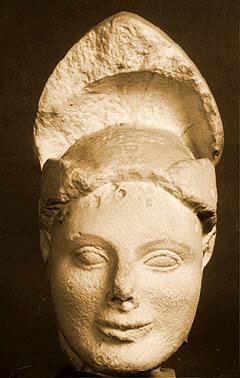
Head of a warrior.
Commentary Prepared by Dr. Julia Lenaghan, Ashmolean Museum
A 041
Head of Warrior from an Early Pediment of the Temple of Aphaia at Aigina. Athens
Marble
Pedimental Figure
22 cm
From Aigina. Found near the head of a woman with covered hair (Furtwängler pls.84 and 11.4) in a cistern north east of the Temple.
Greece, Athens, National Museum, 1934
ca.500-490 BC
Preservation:The head is broken through the neck, just under the chin. The front surface of the nose and the front of the helmet are missing. The left side is abraded. Whereas the face is corroded, the helmet and neck are in good condition.
Description:The head depicts a beardless man who wears a Corinthian helmet. The helmet has been pushed back off his face so that its lower border runs around the head over the brow, the tops of the ears, and down to the nape of the neck. The dome of the helmet extends above and behind the skull of the man.
Between the ears at the front of the head, just below the bottom edge of the helmet are six irregularly spaced holes; two near the right temple, two (one above the other) in the area over the inner corner of the right eye, and two more distantly spaced near the left temple. These holes served for the attachment of a separate piece on which the hair was rendered.
At the back of the head, there are four holes arranged in a rectangular pattern behind the right ear. There appear to be five holes, in a rectangular pattern plus one, behind the left ear. Two or three of these holes may even still be partly filled. In addition, there is a raised strip of rough surface which is about four centimeters wide that runs under the entire back of the helmet. The holes and the surface indicate that the hair at the back of the head was also added separately.
The face is square in shape. The brow and chin are broad and the cheeks are full. The brow, without the fringe of hair, appears tall and slopes forward. The eyebrows are evenly and symmetrically arched. A flat space separates the eyebrows from the upper lid which follow a parallel arch. The lower lid has a less pronounced arch; it is almost horizontal. The two cheeks below the eyes protrude as if they were separate round objects. The mouth is tucked into the face and both lips project. The corners are raised and thus, give the mouth a smile. The upper lip has a small central dip and the lower lip is fuller and has a smooth downward arch. Below the lower lip the strong broad chin projects forward from the face.
Discussion:For a full discussion of the history, both ancient and modern, of the sculpture from the four pediments of the Temple of Aphaia at Aigina, see the discussion of the central figure of Athena from the West Pediment (cat. A 29). This head, found at a distance from both the East and West ends of the Temple but within the Sanctuary, is thought to belong to a figure from one of the first two pediments of the Temple of Aphaia. These two pedimental scenes, depicting an Amazonomachy and the Rape of the Nymph Aigina by Zeus, were taken down shortly after one was completely finished and the other perhaps near completion in favor of more politically imbued stories. After being removed from the pediments, the sculpture were probably placed as decoration in the porticos of the sanctuary.
This head, belonging to a statue of a warrior, resembles another head with a pushed back Corinthian helmet (cat. A 40) that is thought to have come from one of the two early pediments of the Temple of Aphaia. This head differs from the other, also now in Athens, in its lack of a beard and in the rendering of the eyes. Here the eyes lack pronounced inner tear ducts.
Both of the Athens heads that came from the earlier pediments are just slightly different from heads of the West Pediment (for example, see cat. A 29 and A 30). This head is certainly wider and squarer in shape and the face is more divided into distinct sections than the head of the warrior from the West Pediment (cat. A 30). Yet in these two details it is not terribly far from the head of the most conservative figure of the West Pediment, that of Athena (cat. A 29). The attached hair and the type of helmet also distinguish it from the head of the warrior from the West Pediment (cat. A 30). Generally this head is dated just before the figures of the West Pediment.
Bibliography:A. Furtwängler,
Aigina. Die Heiligtum der Aphaia (Munich 1906) p.259 no.119 pls.75-76
catalogue entryS. Karouzou,
National Archaeological Museum. Collection of Sculpture (Athens 1968) p.22 pl.13b
brief catalogue entry