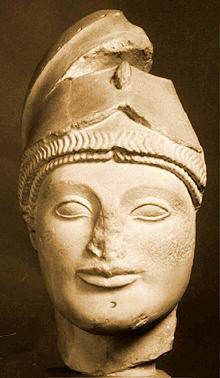
Head of a warrior, with helmet pushed back from face.
Commentary Prepared by Dr. Julia Lenaghan, Ashmolean Museum
A 040
Head of Warrior from an Early Pediment of the Temple of Aphaia at Aigina. Athens
Marble
Pedimental Figure
31 cm
From Aigina. Found in the west corner of the Propylon of the Sanctuary of Aphaia. It was found near another male head, bearded and wearing a helmet, part of which is in Athens and part in Munich—assigned by Ohly to the East Pediment helper of the proper right.
Greece, Athens, National Museum, 1933
ca. 500-490 BC
Preservation:The head is broken through the neck. It is also broken diagonally from in front of the left ear back towards the center of the head. The nose, part of the helmet (mainly the left side), the left ear, and the back portion of the left side of the head are missing. The left side is abraded.
Description:The head depicts a man wearing a Corinthian helmet which is pushed back off his face. The bottom edge of the helmet crosses above the front fringe of hair. The open eye holes rest near the crown of the head and the dome extends up and back beyond the skull. On the curvilinear ridge that separates the dome from the lower portion of the helmet seven small holes are preserved for the attachment of some decorative object. The hole at the central point is the largest.
Underneath the helmet from ear to ear the hair is visible. It hangs in two tiers of wavy strands which are combed from front to back. About five centimeters worth of hair is visible in front of the ear around the temples; much less is visible over the center of the brow. There is a small part directly over the nose in both tiers of the fringe. On both sides of the part the strands of the lower tier of the fringe move diagonally in parallel lines from the center out to the side. The strands of the upper tier of the fringe are longer than those of the lower tier. On either side of the part these strands follow parallel patterns of inverted parantheses.
Behind the right ear, below the bottom edge of the helmet, is a smooth raised band of about four centimeters. Within it and along its border four small holes are preserved. These would have been for the attachment of a roll of hair at the back of the head.
The face is square. The brow is broad and low; the cheek bones are wide-set; the cheeks are full; and the chin is square. The low brow projects and the eyebrows have a high even arch. A smooth flat space separates the eyebrows from the upper lid which follow a parallel arch and have a heavy lid. The lower lid, beginning at the inner corner, rises to form the tear duct and then commences its downward arch. The cheeks below the eyes protrude. The lips are tucked into the cheeks and have raised corners. The upper lip projects beyond the lower lip and has a small central dip. The lower lip has a smooth downward arch directly below which there is an indentation in the facial structure. Below that indentation the solid chin projects.
There are two small shallow holes preserved in the face. One is under the center of the lower lip on the chin and another is in front of the left ear lobe on the side of the cheek. In addition, the surface of the left cheek is corroded until a line a few centimeters from the edge of the face. After that line the surface is smooth. It is smooth also on the chin. Although the right side of the face is not badly corroded as the left, a distinction in the smoothness of the surface can be discerned there too. Clearly a beard, made separately and probably of metal, was attached.
Discussion:For a full discussion of the history, both ancient and modern, of the sculpture from the four pediments of the Temple of Aphaia at Aigina, see the discussion of the central figure of Athena from the West Pediment (cat. A 29). This head, found in the propylon of the Sanctuary, is thought to belong to a figure from one of the first two pediments of the Temple of Aphaia. These two pedimenatal scenes, depicting an Amazonomachy and the Rape of the Nymph Aigina by Zeus, were taken down shortly after one was completely finished and the other perhaps near completion in favor of more politically imbued stories. After being removed from the pediments, the sculpture was probably placed as decoration in the porticos of the sanctuary.
This head, belonging to a statue of a warrior, is just slightly different from the heads of the West Pediment (see cat. A 29 and A 30). The head is certainly wider and rounder in shape and the face is more divided into distinct sections than the head of the warrior from the West Pediment (cat. A 30). Yet in these two details it is not terribly far from the head of the most conservative figure of the West Pediment, that of Athena (cat. A 29). The attached beard, the hair of the fringe, and the type of helmet also distinguish it from the head of the warrior from the West Pediment (cat. A 30). Generally this head is dated just before the figures of the West Pediment.
Bibliography:A. Furtwängler,
Aigina. Die Heiligtum der Aphaia (Munich 1906) pp.259-260 no.120 fig.217 pls.73-74
notes that it is stylistically different than the heads of the West PedimentS. Karouzou,
National Archaeological Museum. Collection of Sculpture (Athens 1968) p.22 pl.13a
brief catalogue entry