Commentary Prepared by Dr. Julia Lenaghan, Ashmolean Museum
A 039
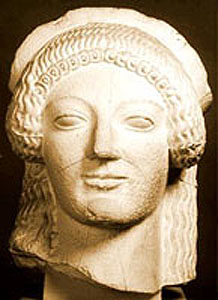
Female Head Possibly from an Akroterion of the Temple of Aphaia at Aigina. Munich
Marble
Acroterion
17.4 cm
From Aigina. Found in front of the east side of the Temple of Aphaia
Germany, Munich, Glyptothek, 91
ca. 480 BC
Preservation:The head is broken through the lower part of the neck, virtually at the base of the neck. The long hair around the neck has also been broken through. The break is higher on the right side. There are chips in the upper edge of the stephane. There is a small circular dowel hole at the top of the head just in front of the crown.
Description:The head depicts a female who has long hair and wears a stephane and earrings. The hair is not parted. It originates at the crown and fall naturally to all sides from that point. Parallel wavy grooves separate the individual strands which are thick. At the back of the head behind the ears the strands fall downward without interruption. They continued beyond the break. Near the center of the top of the head is a hole for the addition of a meniskos.
At the front of the head the strands, falling between the end of one eyebrow and the end of the other, are cut. These strands are less thick than the others and their ends are curled into identical snail curls. Thus, an arched row of snail curls is formed over the brow between the ends of the eyebrows. From the end of each eyebrow to the ear the hair falls downward. When it reaches a level even with the bottom of the ear, it is pulled upward and tucked behind the ear. It then continues downward behind the ear along the side of the neck. The looped hair around the temples has its own volume and stands away from the head. The ear is uncovered and has a circular disc earring in the lobe.
Over the patterned hair rests a stephane. At the front of the head between the ears it is triangular in section. Behind the ears it becomes flat. Moreover, it changes direction. Between the ears at the front of the head it runs parallel to the plane of the forehead. Over the ears themselves it slopes downward and backward. Then at the back of the head it evens out and crosses the back of the head horizontally.
The lower portion of the face is narrow and tapers toward the chin. The upper portion is only slightly broader but the voluminous hair at the temples gives it a much wider aspect. The brow is flat and framed by the symmetrical arch of the row of snail curls. The projecting eyebrows are equally symmetrical and high arched. There is a smooth flat band between them and the upper lids which follow a parallel arch. The upper lid slopes outward. The lower lid has a small horizontal inner corner which forms the tear duct; after this horizontal portion it arches downward. The cheeks are not round. The nose slopes outward without any alteration in direction. The mouth is small with raised corners. The lower lip is fuller than the upper lip and follows a regular downward arch. There is an indentation between the lower lip and the chin which juts outward. The bottom edge of the edge chin has central cleft.
Discussion:For a full discussion of the history, both ancient and modern, of the sculpture from the four pediments of the Temple of Aphaia at Aigina, see the entry concernin the central figure of Athena from the West Pediment (cat. A 29). This head, found in front of the east side of the Temple, was thought initially to belong to an akroterion. It was associated with fragments of a sphinx (Munich Glypt. 159)and placed on the north corner of the East Pediment. Thorvaldsen even restored the heads of the figures of the central akroteria of the West side on the basis of this head.
Yet the large size of the head and the hole in the head for a meniskos suggested to Furtwängler that it was a free-standing figure like many kourai found on the Athenian Akropolis and that the head did not belong to the body of a sphinx. Ohly, however, has most recently reinstated the notion that it belonged to the corner akroterion.
Stylistically, it is thought to be more similar to the figures of the East Pediment than those of the West Pediment. In contrast to the heads thought to come from the earliest pediments and even those from the West pediment, the face of this head is not segmented, (that is the cheeks, nose, mouth, and eyes are not separated but blend together); the shape is narrow and ovoid; and the brow is flat. The head, however, has not stylistically arrived at the more organic natural forms of the heads of the East Pediment. It might be classified as being between the late Archaic West Pediment and the early Classical East Pediment.
Bibliography:A. Furtwängler,
Beschreibung der Glyptothek König Ludwig's I zu München (Munich 1900) pp.119-121 no.91
catalogue entry, notes associated with Glyptothek 159A. Furtwängler,
Aigina. Die Heiligtum der Aphaia (Munich 1906) p.361 pl.98
considers it a free-standing dedication in front of the Temple, chronologically between the West and East PedimentsD. Ohly,
Glyptothek Munchen: Griechische und romische Skulpturen (Munich 1972) p.47 no.4
head of sphinx from akroterion of northeast corner, ca.485-480 BC