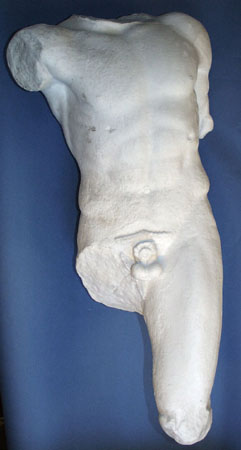
Commentary Prepared by Dr. Julia Lenaghan, Ashmolean Museum
A 034
Staggering Opponent of the Attacking Figure of the Proper Left Side of the East Pediment of the Temple of Aphaia at Aigina. Munich
Marble (Parian)
Pedimental Figure
1.10 m from ground to throat, 0.825 m from break on left leg to throat
From Aigina. The torso was found with in 1811 directly in front of the east side of the Temple of Aphaia. It was found with the Attacking figure of the proper left (II "Priam"), the Helper of the proper left (IV), the archer of the proper left (V "Herakles"), and the Dying Warrior of the proper right (XI "Laomedon").
Germany, Munich, Glyptothek, 87, 119, and 132
ca. 480-470 BC
Preservation:The statue is preserved in the following ten (A-K) segments:
A) The torso to which are attached two fragments of the left arm, the left upper thigh with the genitals, the knee with a shin guard, and a fragment of the right buttocks (5 pieces)
B) Left lower arm with elbow and shield band (1 piece)
C) Left hand (1 piece)
D) Index finger of the left hand (1 piece)
E) Right upper arm (2 pieces)
F) Right forearm with elbow (2 pieces)
G) Fragment of the right shin wearing a greave (1 piece)
H) The tip of right foot with a piece of the plinth (1 piece)
I) Left foot, heel, and beginning of the plinth below it (1 piece)
K) The tip of the left foot with portion of plinth (1 piece) pls.21, 22c, 24
Segments A and D-I are in Munich; segments B, C, and K are in Aigina.
The statue was incorrectly restored in Rome by Thorvaldsen to show a prone figure on the ground. In this restoration the body of the figure hovered over the shield which lay directly on the ground and in which the left arm was still pinned. All the break surfaces were worked back and left with a roughly picked surface that intended to imitate weathering. A head with a crested helmet from the West Pediment was used as the model for the restored head. In addition, the penis, the right arm and hand, the left forearm with the elbow and hand, the shield, the shield band, the shield grip, the left lower leg with a greave, the left foot, flicks in the left thigh and left upper arm, as well as the right leg with the greave and the right foot were all restored. The figure was put on a rectangular plinth and fastened with two heavy iron rods, one went through the left buttock and the other the back. In the buttock they drilled a hole in the ancient surface and in the back they reused an old dowel hole.
This restoration was unsatisfactory and the figure was returned to its original form by Furtwangler. The left lower arm, shield band, and hand, now assigned to the statue were thought by Furtwangler to belong to the opponent of the other attacking warrior of the pediment. Yet a cast made in Athens in 1811 before Thorvaldsen’s restorations gives the original break surfaces and shows, therefore, that this left arm joined this statue.
The latest restorations include the shield but not the shield band and nicks on the arms, the left thigh, and the left knee. The break surfaces, which had been even out by Thorvaldsen, on the throat and on the beginning of the right thigh were hidden, and the drill hole in the left buttocks, made by Thorvaldsen, was filled.
In general the side of torso which faced inwards is better preserved. There is a noticeable path of water damage at the height of the right shoulder that runs in the direction of the arm. This is probably the result of rain water which dripped from the raised sword. There are no traces of paint.
The Ashmolean cast shows only segment A, the torso. It depicts it as it was before any restoration.
Description:The statue depicts a man armed with shield, sword, and greaves who staggers backwards. The upper body, which is turned at the hips slightly to the left, appears to crumple over itself since the waist is sucked in and the head, turned to the left, appears to have tilted downwards. On the right rib cage under the right breast and under the left arm pit are two wounds; the one on the rib cage is deeper than the other. A chipped surface under the edge of the rib cage on the left side is not a wound, but merely incidental damage.
The left shoulder is pulled back and appears raised. Yet the left arm, twisting outwards, hangs down and behind the side of the body. Near the left wrist of the statue is the shield band which has clearly slipped from a position higher up on the forearm. The hand and the fingers hang vertically downwards. The shield itself extended from the back of the biceps, where the outer edge of its interior touched the body, down to the level of the knees. On the back of the left shoulder and on the back of the right buttock are respectively a circular and a trapezoidal dowel hole for the attachment of the shield.
The right shoulder comes forward and turns to the left. The right upper arm projects forward at the same horizontal level. The arm is bent at the elbow and the forearm, projecting yet further outwards, is raised above the upper arm. In the right hand a sword was likely to have been held. Fragments of a marble sword thought to belong to this figure have been found. A nail on the muscle of the left hip likely fixed the sword sheath and band to the body.
Both legs project diagonally forward from the hips. The right leg extends further outwards than the left. The tensed left leg is bent at the knee and the raised heel of the foot, which points forward, is on a plane behind that of the knee. The testicles are pushed up and outward by the thighs which are pressed together and come forward. From the knee to the ankle a greave, whose raised edges are visible above the knee and the ankle, is worn.
Both the skeletal structure and the muscles of the body are naturalistically rendered. The pubic hair, however, is schematically depicted in a diamond-shaped form which has greater width than height.
Discussion:For a full discussion of the history, both ancient and modern, of the sculpture from the four pediments of the Temple of Aphaia at Aigina, see the entry concerning the central figure of Athena from the West Pediment (cat. A 29). This statue belongs to the East Pediment which is stylistically later than the West Pediment in both its total construction and its individual figures. It features fewer figures (eleven rather than thirteen) and the action converges towards the center rather than move outward in small groups. The bodies and heads of the figures are more naturalistically and freely rendered.
This particular statue, depicting a wounded man about to fall, was the opponent of the attacking warrior directly to the left of the central figure of Athena. The bottom blocks of the pediment seem to assure this position as does the stance. The virtually erect posture of the figure means that it must have stood near the center of the slanting pediment and the weathering of the figure makes it clear that the left side of the statue faced outwards to the viewer. Thus, its placement within the total composition of the pediment is secure.
The statue has had a complex modern history. Thorvaldsen restored it in a manner called by Ohly “indiskutabel und grotesk”. The figure was placed in an entirely unrealistic position. With the left arm still in the shield band and the shield on the ground, the body rested several centimeters over the shield, impossibly supported by the left arm. The raised right arm still brandished a sword.
In the twentieth century, first Furtwängler and then Ohly have made progress in correctly re-restoring the statue. New fragments and careful assessment have allowed Ohly to reconstruct almost the entire statue. Unfortunately, no traces of the head, without a helmet and likely expressive of a moment between life and death, have been found. Ohly notes that the figure is stylistically identical to the statue depicting its attacking opponent. He conjectures that both figures may have been created by the master of the sculptural workshop itself.
Bibliography:A. Furtwängler,
Aigina. Die Heiligtum der Aphaia (Munich 1906) pp.244-248 H nos.77-81 pls.96, 99, and 100
description of statueD. Ohly,
Die Aegineten I. Die Ostgiebelgruppe (Munich 1976) pp.41-50 pls.19-24, 44c, 73-74, 76
extremely detailed technical description of all aspects of the statue