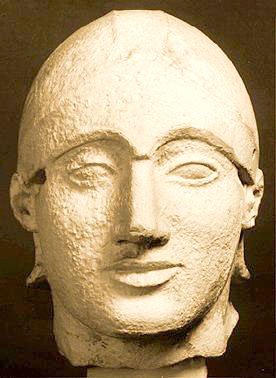
Helmeted head of on archer. Cheek pieces were added separately.
Commentary Prepared by Dr. Julia Lenaghan, Ashmolean Museum
A 032
Head of a Helper from the East Pediment of the Temple of Aphaia at Aigina. Munich
Marble (Parian)
Pedimental Figure
23.5 cm
From Aigina. The head was found with in 1811 in the Pronaos of the Temple of Aphaia. It was found with the head of Athena that belonged to the central figure of the pediment.
Germany, Munich, Glyptothek, 90
ca. 480-470 BC
Preservation:The head is broken through the neck. Part of the nose protector and the cheek pieces, originally made separately, are missing. The helmet has painted decoration; a net-like pattern made of individual dots appears across the front. In addition, there are traces of intense red, especially on the inside of the neck guard and Furtwängler saw traces of a blue which are no longer extant. Thought to belong to the same statue are the following fragments: The left thigh, the left lower leg, the left foot, the right leg with part of the right butthocks, and the right foot. Some of these are in Aigina and some are in Munich..
Description:The head depicts a beardless man who wears a Chalcidian helmet. The lower portion of the front of the helmet follows the shape of the eyebrows and it would have covered the ridge of the nose. At the temples directly in front of the small uncovered ears there are deep rectangular slots below the bottom edge of the helmet; the left of these is full. Clearly hinged cheek pieces were added separately. In addition, on the left side there is a circular hole in the helmet near the bottom edge directly above the center of the rectangular slot. On the right side there is no supplementary dowel hole but there is a small empty space directly in front of the ear where a portion of the cheek piece would have fit. The hinged pieces appear to have been in a raised position since the surface of the face is uniformly weathered.
Over the bridge of the nose is a small attached fragment of the nose guard which was made separately and has broken off. Above the front triangular visor area is a flat band which runs down the center of the helmet from the front to the back. Around the right ear the raised edge of the helmet is entirely rendered but it was not depicted around the left ear which was clearly the side that faced the back of the pediment. Behind the ears is the neck guard which flares outward at its end. Below its entire flaring bottom border are small holes, some of which fall partly on the break surface. These must have been for the addition of hair which was probably painted red since traces of red paint were found on the inside of the neck guard.
The face itself has an oval shape that derives from the long smooth flat cheeks, the “U” shaped chin, and the fact that the forehead and eyebrows are concealed by a rounded helmet. The eyes are ovoid and thick rimmed. The upper lid projects and arches. The lower lid is more horizontal. The nose is prominent, long, and has a broad ridge. Below the nose is a horizontal mouth. It features thick full lips which are rounded in form. The upper edge of the lower lip is given a small central rounded indentation. The chin is broad and projects.
Discussion:For a full discussion of the history, both ancient and modern, of the sculpture from the four pediments of the Temple of Aphaia at Aigina, see the entry concerning the central figure of Athena from the West Pediment (cat. A 29). This head belongs to the East Pediment which is stylistically later than the West Pediment in both its total construction and its individual figures. It features fewer figures (eleven rather than thirteen) and the action converges towards the center rather than move outward in small groups. The bodies and heads of the figures are more naturalistically and freely rendered.
Ohly has assigned this particular head to the “Helper” figure (no.IX) who stands between the Trojan archer (no.X) and the backward falling warrior (no.VIII) on the proper right side of the pediment. This “Helper” figure would be lunging forward to assist his wounded companion (no.VIII). Ohly’s reason for connecting this head to that “Helper” figure are twofold. First, the right side of the head is intended as the principal viewing angle. This is clear from details like the edge of the helmet around the ear and the lack of the additional dowel hole for the right cheek piece. This necessitates that the head come from the proper right side of the pediment since only one figure on the left side of the pediment turns the right side of his face to the viewer and this figure already has a head. Among the figures of the proper right side of the pediment, the attacker (no.VII, “Telamon”) can be excluded because he faces the wrong way, the figure who steps backward (no.VIII) can be excluded because this head is upright, and the dying warrior (no.XI, “Laomedon”) can be excluded because his head is preserved. Here Ohly’s second point comes in. He points out that the neck of this figure cranes forward and the head remains frontal. This neck and position is exactly that of the “Helper” figure of the proper left side of the pediment (no.IV); it is the position of a man straining forward.
Furtwängler had previously thought that the head belonged on the archer of the proper right side (no.X), the figure directly behind the “Helper”. He thought that the helmet without a crest was a proper pendant to the archer of the proper left side (no.V) who, wearing a lion skin, also has no crest. Ohly correctly rejects this attribution since the head of the archer of the proper right side must have turned toward the left shoulder.
Bibliography:A. Furtwängler,
Aigina. Die Heiligtum der Aphaia (Munich 1906) pp.229-230 no.B
believes head to be that of the archer of the proper right side of the East PedimentD. Ohly,
Die Aegineten I. Die Ostgiebelgruppe (Munich 1976) pp.92-95 pls.52-54
extremely detailed technical description of the head which is ascribed to the figure of the helper from the proper right side of the East Pediment