Commentary Prepared by Dr. Julia Lenaghan, Ashmolean Museum
A 020
Herakles and Kyknos (Metope 21); Athenian Treasury, Delphi
Marble (Parian)
Metope
H 68 cm
From the Athenian Treasury at Delphi. Found in 1893 off the north-east corner of the treasury, between the treasury and the bouleuterion.
Greece, Delphi, Museum, 749
Late Archaic, after 490 BC
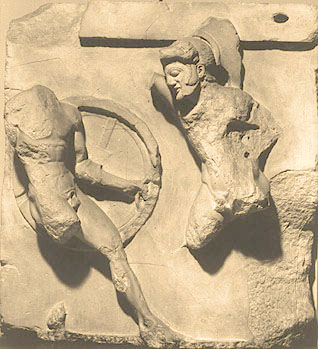
Preservation:The figure on the left is missing its head, right arm, and most of the right leg. The figure on the right has lost most of both arms and legs; a large section of the torso is heavily damaged. The surface of both figures is heavily scored and abraded in places. Both upper corners, and the lower right corner of the metope with a section of the relief ground have broken off (partly restored on the cast).
Description:The metope depicts two nude warriors fighting. They are carved in high relief and slightly turned into a three-quarter view. The warrior on the left holds a round hoplite shield on his left arm, his right arm was held downwards. Traces of his helmet remain on the relief ground. Wounded, his body is inclined backwards, supported by the right leg that is set far back. His opponent is attacking in wide stride from the right, his right arm is raised and bent backwards, ready to strike. The hand with remains of a sword is visible over the forehead. This warrior wears a helmet with a long crest, partly covered by an animal skin. Traces of the metal blade of his sword remain; a large square dowel hole in his left flank must have been used for the attachment of a metal shield.
Discussion:The Athenian Treasury at Delphi is the latest in a whole series of such buildings in the sanctuary. A small Doric edifice in antis, it was built entirely of Parian marble on a prominent section of the Holy Way. The date for its erection remains controversial: Pausanias (10.11.5) states that it was built of the spoils from the battle of Marathon (490 BC) but on stylistic grounds many scholars prefer a date about a decade earlier. It is possible that Pausanias read the inscription of an Athenian anathema dedicated in front of the treasury and mistook the date given there as the one referring to the entire structure, but the sculptures do not necessarily elicit doubt on his date.
The treasury had sculptured metopes, pediments and acroteria, and is remarkable in the way myths with a particular reference to Athens are strongly promoted in the decorative scheme. The pediments showed battle scenes, possibly an amazonomachy in the east; mounted amazons formed the acroteria. The 30 metopes of the building depicted the deeds of Heracles and Theseus, the old and new ‘national’ heroes of Athens.
Theseus, closely associated with the newly established democracy, dominated the southern side, which would have been the first visible to the visitor of the sanctuary. The more obscured west metopes showed a single adventure of Heracles, the abduction of the cattle of Geryoneus. The attribution of the other metopes and their precise content is largely conjectural. Further deeds of Heracles may have been shown on the north side, and an amazonomachy on the front. In this case Heracles would have been relegated to the two more obscured sides of the building. According to a more recent reconstruction, the amazonomachy of Theseus was depicted on the north, and labours of Heracles on the east. With this arrangement the two heroes would be more evenly balanced. The find contexts of the metopes are too imprecise to allow any definite solutions.
The metopes are carved in high relief; their original appearance would have been even more striking through the addition of paint and metal attributes. Although clearly still in the archaic manner, the figures show great advancements in the depiction of anatomical details and composition, leading the way to early Classical sculptures. The confined space of the metopes has been most effectively used through a great variety of different poses and motifs.
This metope shows Heracles (marked out by the lion skin over his helmet) fighting with Kyknos, the son of Ares, who threatened travelers on the way to Delphi. This was one of the nine labours chosen for the treasury. The dynamic poses of the adversaries heighten the sense of drama; Heracles is about to deal the final blow to his wounded opponent.
See also A 21-23.
Bibliography:J. Audiat,
"Le Tresor des Atheniens" (FdD II 1933)
Gives a full account of the architecture and reconstruction of the treasury.P. de la Coste-Messeliere,
"Sculptures du Tresor des Atheniens" (FdD IV 4 1957) 128-135 figs. 59-64
The thorough original publication of the sculptures. The Theseus metopes are reconstructed on the south and east sides, the Heracles metopes on the west and north. Following Pausanias a date after 490 BC is proposed.K. Hoffelner,
"Die Metopen des Athener-Schatzhauses. Ein neuer Rekonstruktionsversuch" (AM 103 1988) 77-117 foldout 5 (esp. 95; 97 fig. 21)
Provides a detailed description of the metopes. H. argues for a date before 490 BC and offers a different reconstruction (Theseus metopes on south and north, Heracles metopes on the east and west sides; some 'Heraclesmetopes' are ascribed to Theseus.H. Knell,
Mythos und Polis (Darmstadt 1990) 52-63
Is a comprehensive account of the sculptural decoration and the chronological arguments.